Why Training New Staff Takes So Long (and How to Fix It)
Training new staff takes too long in multi-location businesses mainly because knowledge lives in people instead of in the system: standards are hard to find, training depends on who is on shift, and nobody checks readiness against a clear definition. Fix it with short role-based learning paths, instructions available at the point of work, a structured first week and a readiness sign-off per task.
The real cost of slow training
Every chain knows the feeling. A new person starts on Monday, and three weeks later they still ask where things are, still need someone next to them at the register and still make the same mistakes. Meanwhile your best people spend their shifts training instead of serving guests.
With staff turnover a fact of life in hospitality, retail and service, slow onboarding is not a one-off cost. It repeats every time someone new starts, in every location. Shortening the time from first shift to fully productive is one of the most valuable things an operations team can do.
The good news: training is rarely slow because new people are slow. It is slow because of how knowledge is organised.
Five reasons training takes too long
1. Knowledge lives in people, not in the system
When the real way of doing things is in the heads of experienced staff, every new person depends on who happens to be on shift. Good trainers produce good staff. Busy or impatient trainers produce shortcuts.
2. Standards are hard to find or out of date
If the manual is a long PDF on a back-office computer, nobody opens it during a shift. New staff ask a colleague instead, and the colleague answers from memory.
3. Training is separate from the work
Courses are done in a classroom or on a laptop, then the person goes to the floor and has to remember everything. People learn most while doing, so instructions need to be available at the moment of the task.
4. No clear definition of "ready"
Without a clear readiness standard per task, the manager guesses. Some people are pushed onto a station too early, others are held back for weeks. Both waste time.
5. Every location does it differently
Each store manager builds their own onboarding. Some are excellent, some barely exist, and HQ has no way to see the difference until quality varies.
What good onboarding looks like
The aim is not to make training longer or more formal. It is to make it more structured and easier to follow:
- Role-based paths. A barista, a cashier and a shift lead need different content. Give each role a short path, not one generic programme.
- Short modules. A few minutes per topic, on the phone, with photos or short videos of the correct result.
- Learning in the flow of work. The same instruction used in training is one tap away during the shift. See LMS vs learning in the flow of work.
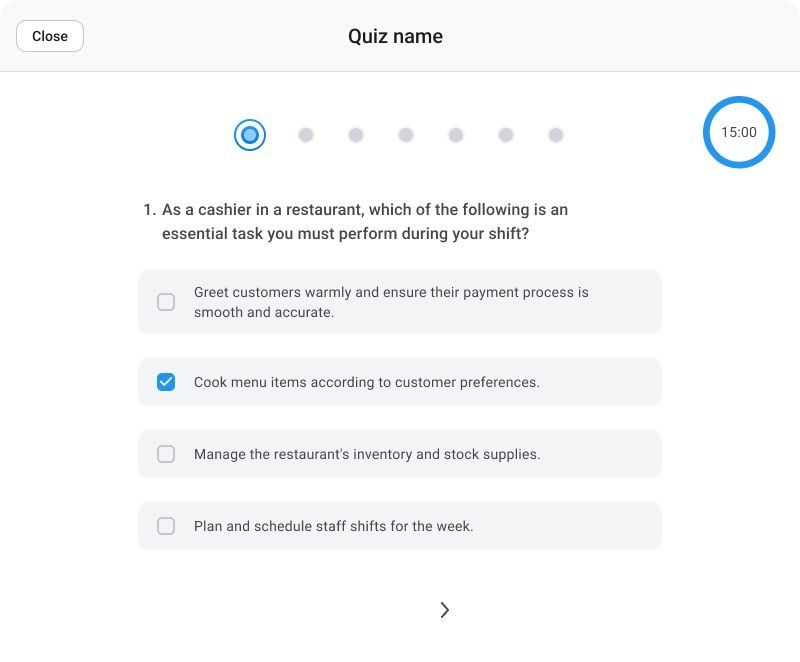
- Check understanding. A short quiz after each critical module shows what has stuck.
- Readiness sign-off. Each task is signed off by a manager after supervised practice.
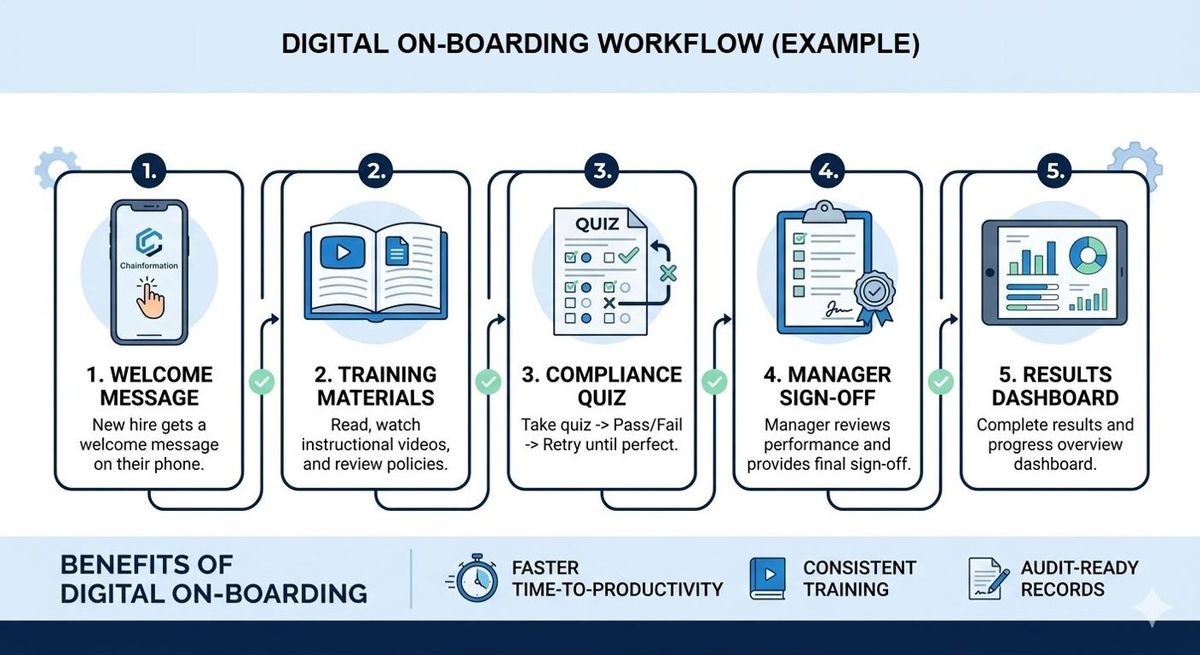
A sample week-one plan
Use this as a template and adapt it to your roles. The point is that every location follows the same plan.
| Day | Focus | Learning (short modules) | On the floor | Check |
|---|---|---|---|---|
| Day 1 | Welcome and safety | Welcome from HQ, concept and values, safety and hygiene basics | Tour, meet the team, shadow one station | Safety quiz |
| Day 2 | First station | Station procedure with photos, quality standard | Supervised practice on station 1 | Trainer feedback |
| Day 3 | First station plus routines | Opening or closing routine, how to report a problem | Station 1 with less support, join a routine | Quiz on the routine |
| Day 4 | Second station | Station 2 procedure | Supervised practice on station 2 | Trainer feedback |
| Day 5 | Readiness | Recap of key standards | Work a normal shift with a buddy | Manager sign-off on station 1, plan for week 2 |
Want a ready onboarding path for each role? Book a short intro and we will show how chains build role-based onboarding that runs the same way in every location.
Role readiness checklist
A new team member is ready for a station when every point below is signed off. Keep it the same across locations.
- ☐ Has completed the station's learning module and quiz
- ☐ Can find the station procedure on their phone without help
- ☐ Has done the task under supervision at least twice
- ☐ Meets the quality standard (photo or manager check)
- ☐ Knows the food-safety or safety points for the station
- ☐ Knows how to report a problem or Not OK
- ☐ Has been signed off by the manager in the system
Make the trainer's job easier
In most locations, the trainer is a busy shift lead or an experienced team member who also has to serve guests. If training depends on their energy and memory, it will vary. Give them tools instead:
- A trainer's guide per station. What to show, in which order, and what to check before sign-off.
- The same content the new person sees. When both look at the same procedure on a phone, the trainer demonstrates and the system remembers.
- A clear sign-off step. The trainer or manager records that the task was done to standard, instead of a vague "she's fine on the register".
- Time in the rota. Plan training shifts with a little slack. Training squeezed into the lunch rush teaches shortcuts.
This also protects your experienced people. Being a good trainer becomes a defined, visible part of the job, not an invisible extra load. Recognise it.
Updating existing staff is training too
Onboarding gets the attention, but every change to a recipe, campaign or procedure is also training. When an update arrives as a long email, many staff never see it. Send changes as short modules to the roles affected, ask for a read confirmation on what matters, and add a check to the routine where the change applies.
Common mistakes
- Information overload on day one. Long welcome sessions are forgotten. Spread content over the first weeks and teach what is needed next.
- Shadowing without structure. Following an experienced colleague is useful only if both know what should be learned and checked.
- Training only at the start. When a procedure changes, existing staff need the update too. Use read confirmation and a short quiz for changes that matter.
- No feedback loop. If many new starters fail the same quiz question, the content or the procedure probably needs work.
How to measure training time
| Metric | Definition | Why it matters |
|---|---|---|
| Time to first sign-off | Days from start to first station signed off | Your core speed measure |
| Time to full readiness | Days until all role tasks are signed off | Shows the full ramp-up |
| Onboarding completion | Started onboardings completed on plan ÷ started | Shows whether the plan is followed |
| Quiz first-time pass rate | Passed on first attempt ÷ attempts, per module | Points to unclear content |
| Early leavers | New starters who leave within the first weeks | Poor onboarding is a common reason |
Measure per location. A large gap between locations usually says more about the onboarding than about the people.
How Chainformation helps
In Chainformation, onboarding paths are built per role with short modules, files, quizzes and to-do lists, and can start automatically when a new user is added. The same instructions live in the digital manual, so staff can look them up during the shift. Managers sign off progress, and HQ sees onboarding status across all locations. When a procedure changes, the update can go out with a read confirmation and a quiz.
See staff onboarding and training, digital manuals and handbooks, and our in-depth post on the franchise onboarding process.
Shorten the road from first shift to fully productive. Book a 15-minute intro and we will show a complete onboarding flow, from welcome message to manager sign-off.
FAQ
Why does it take so long to train new people on our brand standards?
Usually because the standards are long, scattered or out of date, so new people learn by shadowing whoever is on shift. Each trainer teaches a slightly different version, and nobody confirms that the new person can actually do each task to standard.
How long should onboarding take for frontline staff?
It depends on the role and the risk. Define readiness per task instead of per calendar: a new team member is ready for a station when they have been shown it, done it under supervision and been signed off by a manager. Track how long that takes and work to shorten it.
What should a new employee's first week look like?
Day one covers welcome, safety and the basics of the concept. Days two to four combine short learning modules with supervised practice on one or two stations. Day five is a readiness check and a conversation about the next week. Each step should be in the same plan in every location.
Is an LMS enough to train frontline staff?
An LMS is good for formal courses and certificates, but frontline staff learn most while doing the job. They need short instructions on their phone at the point of work, connected to the routines they perform. Many chains combine both or use a workspace that includes both.
How do we keep training consistent across locations?
Use the same role-based learning paths, the same readiness checklist and the same sign-off process everywhere, and let area managers see onboarding progress per location. The local trainer still matters, but they teach from the same standard.
Canonical: /resources/guides/why-training-new-staff-takes-so-long