Operational Drift: How to Spot and Stop It Across Locations
Operational drift is the gradual slide of locations away from the agreed way of working through small shortcuts, outdated knowledge and unverified routines. To stop it, make standards easy to follow, build early signals into daily routines (values, photos, OK / Not OK, read confirmation), route deviations to an owner, and review patterns with each location weekly so small variations are fixed before they become habits.
What operational drift is
Operational drift is the slow movement away from the agreed way of working. It rarely starts with a decision. It starts with a skipped step on a busy evening, a shortcut that seemed harmless, an old printout on the wall or a new manager who trains staff from memory. Each change is small. Six months later, the location runs its own version of the concept and nobody can say exactly when it happened.
Drift is the reason the same brand can feel different from one location to the next. It is also why audits so often surprise head office: by the time an auditor sees it, the deviation has become the normal way of working. As we argue in A concept without control is no concept at all, a concept only exists to the extent it is executed.
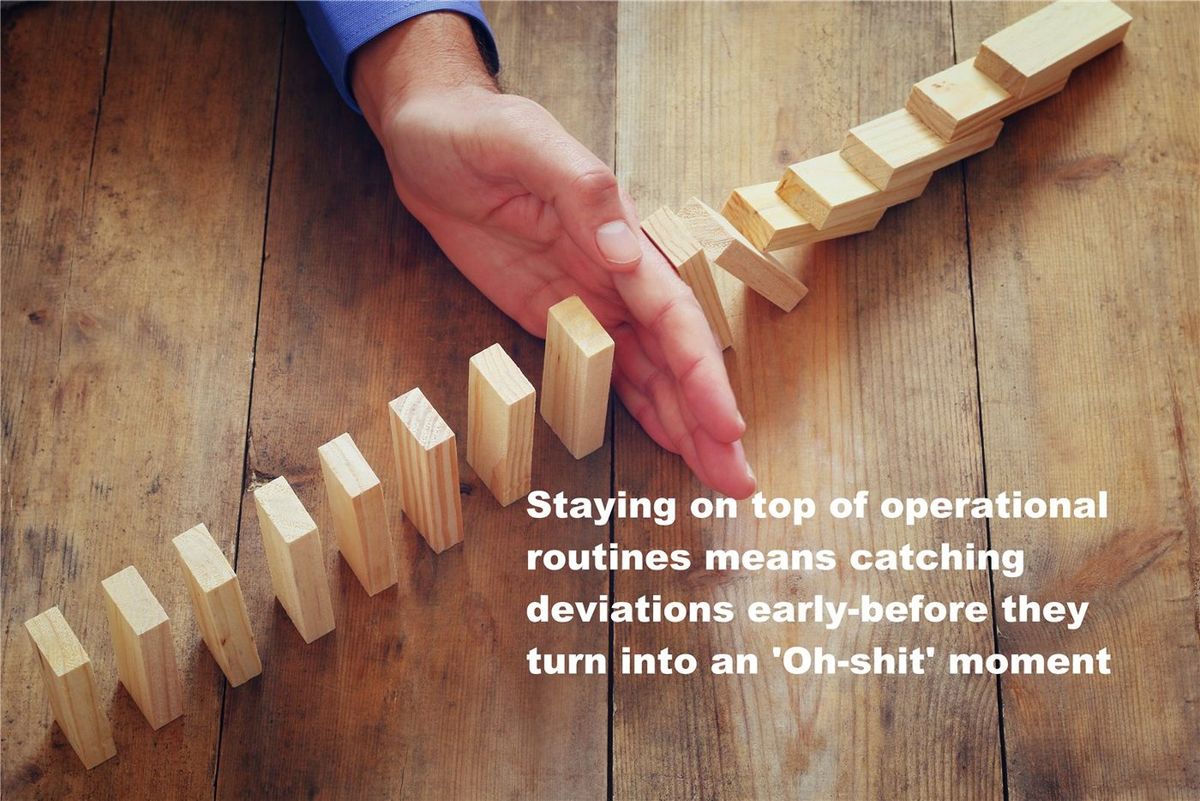
Why drift is so hard to see
Drift hides in plain sight for three reasons. First, it is gradual: no single day looks very different from the day before. Second, it often looks like initiative: a local workaround can feel smarter than the standard, and sometimes it is. Third, most monitoring is too slow: quarterly audits and annual reviews show the result long after the habit was formed.
That is why the answer is not more audits. It is earlier signals, built into the work that already happens every day.
Six early warning signals, with examples
- Routines finish late or in a rush. The opening checklist is completed 20 minutes after doors open, or all points are ticked within one minute. Both mean the routine is no longer guiding the work.
- Ticks without evidence. Points that should have a value or photo are just marked done. "Fridge OK" every day, never a temperature.
- Updates not confirmed. A location has not confirmed the last three mandatory updates. They are working from an older version of the concept.
- The same Not OK keeps coming back. The ice machine, the display, the restroom: the deviation is reported, closed and reported again.
- Local documents appear. Handwritten notes, local printouts and private chat groups replace the official procedures.
- Onboarding shortcuts. New staff are put on stations without completing training or sign-off, because "we are short this week".
None of these is a disaster on its own. Together, and repeated, they are the early shape of drift.
A 10-question drift self-assessment
Answer yes or no for one location, or for your network as a whole. Each "no" is a place where drift can grow unseen.
- Can every employee find the current procedure for their task on a phone within a minute?
- Is there only one current version of each standard?
- Do updates go out in one channel, with read confirmation for critical changes?
- Are the critical standards part of a scheduled daily or weekly routine?
- Do critical points require a value, photo or OK / Not OK, not just a tick?
- Does every Not OK have an owner and a deadline?
- Can HQ or the area manager see repeated deviations per location without asking?
- Does every new employee follow the same onboarding path and sign-off?
- Are routine results reviewed with each location at least weekly?
- When many locations fail the same point, do you change the standard or the equipment?
Seven or more "yes" answers means you have a solid base. Four to six means drift is likely in some areas. Three or fewer means you are probably finding out about drift from guests.
Want to run the self-assessment with us? Book a short intro and we will go through the ten questions for your network and show where the early signals would come from.
How to stop drift: a practical plan
Make the standard easy to follow
Drift often starts where the standard is unclear. Rewrite critical procedures into short, visual steps that fit a phone screen, and remove old versions. If staff cannot find or understand the standard, they will invent their own.
Build signals into daily routines
Put the standards that matter most into the shift rhythm: opening, pre-peak, closing and weekly. Ask for values on measurements and photos on visual standards. Now each routine produces data, not just a tick. See how to know if daily routines are actually completed.
Route deviations to an owner
A Not OK should reach the person who can fix it, become a task with a deadline and be closed with a comment or photo. Without this, deviations become noise.
Review patterns, not incidents
Once a week, look at each location's routines and deviations with the store manager or franchisee. Focus on patterns: what repeats, what is late, what has improved. Use the data to support, not to blame.
Fix the system when many locations drift the same way
If ten locations skip the same point, the problem is probably the standard, the equipment or the timing, not ten managers. Update the standard, send it with a read confirmation and adjust the routine.
Before and after: an illustrative example
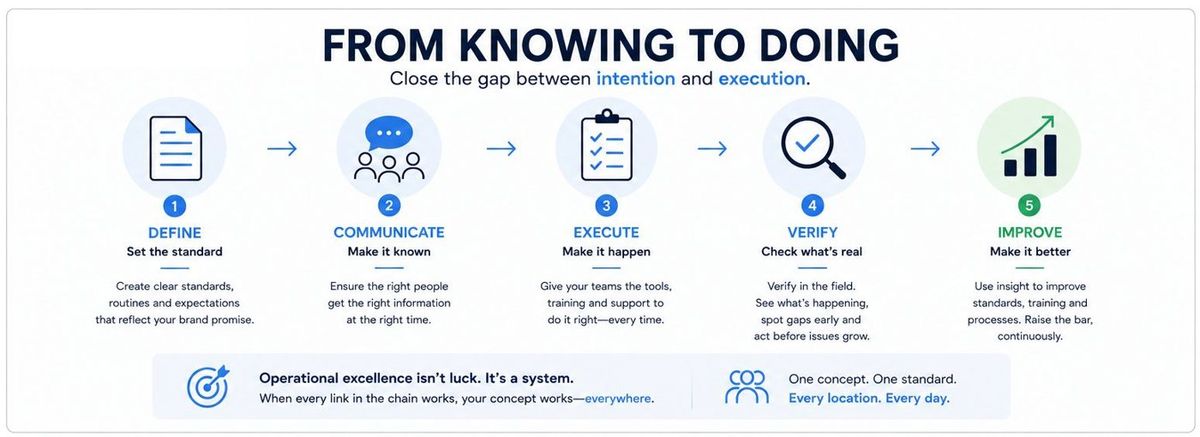
This example is illustrative, not a specific customer. A retail chain with around 30 stores launches campaigns every month. Before: campaign material goes out by email with a PDF guide. Some stores set up on time, some late, some only partly. HQ finds out from store visits and photos sent in chat groups, if at all.
After: each campaign goes out as a targeted update to store managers with a read confirmation, and a campaign checklist with a deadline and a required photo of the finished display. Stores that miss the deadline or answer Not OK show up in the area manager's view the same day, and the area manager calls those stores instead of visiting all of them. Over a few campaigns, the team can see which stores repeatedly struggle and why.
Who owns drift?
Drift is everyone's problem, which often means it is nobody's job. Make ownership explicit. Head office owns the standards and the system: clear procedures, one channel for updates, routines that produce signals. Area managers own the weekly review and coaching with their locations. Store managers and franchisees own daily execution and the closing of deviations. Shift teams own honest answers. When each level knows its part, drift has fewer places to hide.
Common mistakes
- Relying on audits alone. They are a snapshot, not a monitoring system.
- Adding more points to every checklist. Long checklists produce ticking, which hides drift.
- Punishing reported deviations. If reporting a Not OK leads to trouble, people stop reporting, and drift goes underground.
- Treating all variation as drift. Be explicit about where locations have freedom. Good local ideas can improve the standard for everyone.
How Chainformation helps
Chainformation gives multi-location operators one flow for standards, updates, checklists, audits, deviations and reporting. Updates go to the right roles with read confirmation. Routines collect values, photos and OK / Not OK answers. Deviations reach the right person and are tracked to closure, and HQ and area managers see per location where routines are late, unconfirmed or repeatedly failing. Learn more about operational drift and multi-location compliance, or read how to improve consistency across multiple locations.
Catch drift before your guests do. Book a 15-minute intro and we will show what the early warning signals look like in a real network view.
FAQ
What is operational drift?
Operational drift is when locations gradually move away from agreed standards and procedures through local shortcuts, missed routines, outdated instructions or training from memory. Each step is small, but together they change the concept the guest experiences.
What causes operational drift in multi-location businesses?
The most common causes are standards that are hard to find, updates spread over too many channels, new managers learning from local habits, routines that are ticked without evidence, and follow-up that happens only at audits or after complaints.
How can head office detect drift early?
By building signals into daily work: temperature values and photos in routines, OK / Not OK answers, read confirmation on updates, repeated deviations per location and completion trends. These show drift weeks or months before an audit or a bad review would.
Is all local variation drift?
No. Some local adaptation is healthy and sometimes improves the concept. Drift is unplanned variation on things that should be the same everywhere. Decide which standards are fixed and where locations have freedom, and make that explicit.
How often should multi-location operations be audited?
Formal audits are useful a few times a year, but they cannot catch drift on their own. Combine them with daily and weekly routines and weekly reviews of deviations, so problems are found and fixed between audits.
How do you stop drift without micromanaging franchisees?
Give franchisees and managers the same data HQ sees, agree which standards are non-negotiable, and use follow-up to help rather than to blame. When locations can see and fix their own deviations, HQ only needs to step in where patterns persist.
Canonical: /resources/guides/how-to-reduce-operational-drift-across-multiple-locations